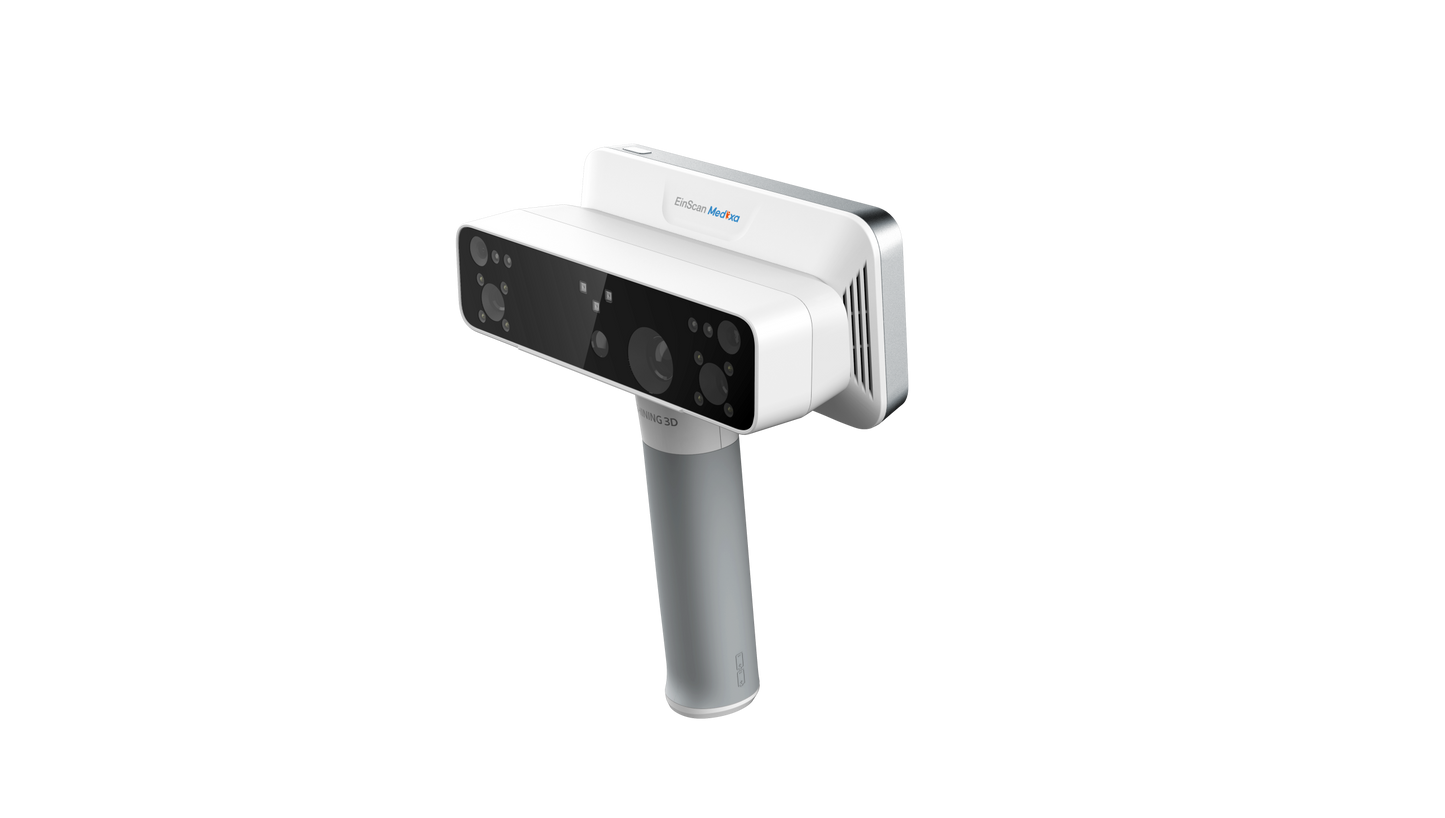
EinScan Medixa Medical 3D Scanner

EinScan Medixa Medical 3D Scanner

SKU: EinScan-Medixa
Regular price $7,099.00 CAD
Sale
Sold out
Sale price

Price

$7,099.00 CAD Regular price

Stock

Quantity
Alert: First Batch ETA 1st week of Dec. Available for Pre-order.

Product Details

Technical Specs

Overview
Footprint (L× W× H) (H*D*W) 233 × 180 × 91 mm
Net Weight 953g
Performance
Accuracy RMS* < 0.3
Working Area & Optics
Field of View White Light 475x360mm | Infrared VCSEL 1090x1260 mm
Working Field Distance White Light - 200~600 mm| Infrared VCSEL 160~1500mm
Camera 5MP
Software & Workflow
Supported File Types Output formats: STL, OBJ, PLY
Connectivity
Wi-Fi Wi-Fi 6
USB USB- Type C
Cloud Connectivity Shining3D Cloud
Input Voltage Battery: 5500mAh × 2; Support USB-C 60W-PD3.0 Charger
Safety Features

LED Light (Eye safe)
Class I (Eye safe)

Warranty and Support
Manufacturer Warranty 1 year manufacture's
Shop3D Warranty 1 year manufacture's warranty
Shop3D Training

Shop3D or Manufacturer Training Sessions Optional

Documentation

3D Scanner

EinScan Medixa

A wireless, all-in-one 3D scanner is designed specifically for orthotics and prosthetics, integrates simplified workflows with onboard processing to eliminate the need for an external computer during scanning. The contact-free, fully digital method empowers O&P clinicians to deliver patient care with greater efficiency, precision, and ease.

Features

All-in-One Design for Maximum Efficiency

EinScan Medixa combines scanning, processing, and data export all in one device.

  • Lightweight & portable: Easy to carry and use in various environments, whether in the clinic or on-site.
  • Standalone operation: No need for an external computer, simplifying setup and use.
  • Quick & convenient: Less time spent on the scanning process, improving patient throughput.

Tailored Workflow

With an intuitive, step-by-step interface, EinScan Medixa enables clinicians without 3D scanning experience to operate efficiently, reducing appointment times.

  • Optimized for O&P: Designed specifically for orthotic and prosthetic workflows, streamlining clinical operations.
  • Minimal training required: Reduces the learning curve for non-technical staff and clinicians.

High-Precision Results

  • High-quality 3D data: Pre-set scanning parameters deliver accurate 3D models in STL, OBJ, and PLY with minimal post-processing, seamlessly integrating with CAD/CAM and O&P design software.
  • Consistency in accuracy: Unlike manual methods requiring multiple measurements, EinScan Medixa ensures precision in one scan.

Movement Compensation

Advanced algorithms compensate for slight movement from the patient during scanning, especially when capturing 3D data of infant heads for cranial helmets or torsos affected by breathing.

High-Resolution Texture Capture

Equipped with a 5MP texture camera, EinScan Medixa captures both precision geometry, and high-resolution surface textures drawn by clinicians, enabling accurate 3D modeling for customized O&P devices.

Contact-Free Scanning

  • Non-contact technology: Uses white and infrared lights to capture high-quality 3D body models without physical contact.
  • Comfortable for patients: The process is faster, cleaner, and more comfortable compared to the mess and discomfort of traditional plaster casting methods.
  • Improved patient satisfaction: Non-invasive scanning reduces patient stress, especially for children and elderly patients.

Flexible Integration & Customization

EinScan Medixa supports smooth data transfer with hospital ordering systems and design portals. Customizable features enable tailored clinical workflows and branded experiences, enhancing integration within varied healthcare environments.

How Does 3D Technology Enhance Orthortics & Prosthetics?

Orthotics and prosthetics clinics sought to cut production time and expenses for custom devices, while ensuring greater accuracy and patient comfort.

Category Traditional Method 3D Digitizing Method
Method Plaster casting, tape measure, manual drawings, CAD modeling, milling Contactless 3D scanning with EinScan Medixa, auto CAD conversion, direct to fabrication
Materials used Plaster, foam boxes, and manual tools None (fully digital)
Accuracy Inconsistent, operator-dependent, multiple measurements to take average values One-time scanning, high-accuracy results
Data archiving Not good to track Data is documented and is to be used to compare in the follow-up assessment
Rework rate 15 ~ 20% < 3%
Patient experience Messy and traumatic Clean and comfortable
Time per step (Take cranial for example) Casting: 30 minutes
Measurement: 1 hour
CAD design: 3 hours
Milling and finishing: 30 minutes
Scanning: 30 seconds
Post-processing & CAD: 20 minutes
Milling and finishing: 30 minutes
Total time per case 5 hours 1 hour
Patient throughput (per 8h workday) 1.6 patients / day 8 patients / day
Time savings 80% reduction in time
Patient throughput increase 400% increase in capacity